A repair job can feel like a promise: the house will be cool, the noise will stop, the bills will behave. Yet not every repair delivers perfection the first time. In Tucson summers, when a system is the difference between sleepless heat and a livable night, you need a sensible, hands-on verification routine that separates solid work from something that will need a return call. This article shows practical tests, what numbers to expect, when to call your contractor back, and how to talk to technicians so you get lasting results.
Why testing matters
Repairs can be corrective, replacing a broken component, or preventive, fixing wear before failure. Either way, an incomplete test leaves risks: refrigerant leaks that slowly degrade performance, https://claytonvixb880.cavandoragh.org/how-to-find-emergency-ac-repair-near-me-during-peak-season-in-tucson an airflow imbalance that stresses motors, or control issues that let the system cycle too often. In a place where daytime temperatures commonly top 100 F, those risks are not theoretical. A thorough post-repair check preserves comfort, extends equipment life, and protects your wallet.
Start at the thermostat
A lot of people skip simple thermostat checks, and that causes unnecessary callbacks. Set the thermostat to cooling, choose a temperature at least 5 to 7 degrees below your room temperature, and observe what happens over the next 10 to 15 minutes. The system should start within a minute or two. If it waits longer, cycles repeatedly without steady runtime, or refuses to start, note exactly what you saw, including any error codes if the thermostat shows them.
Feel the vents
After the system has run for 10 to 20 minutes, inspect several vents in the house. The supply vents should deliver noticeably cooler air than the room. In most healthy systems, the difference between supply air and return air at the register should be roughly 14 to 20 F when running long enough to reach steady state. If you can only access return air near the filter or closet, measure there and compare to the nearest supply.
Listen and look outside
Step outside and watch the condenser unit. It should be running smoothly, the fan rotating without wobble, and no unusual clanking or grinding noises. Observe the compressor sound, and note whether the fan speed modulates or holds steady. Some high-efficiency systems will vary speed quietly, which is fine. Loud rattles, brief shutdowns followed by restart, or a smell of burnt insulation are not fine.
Check temperatures with simple tools
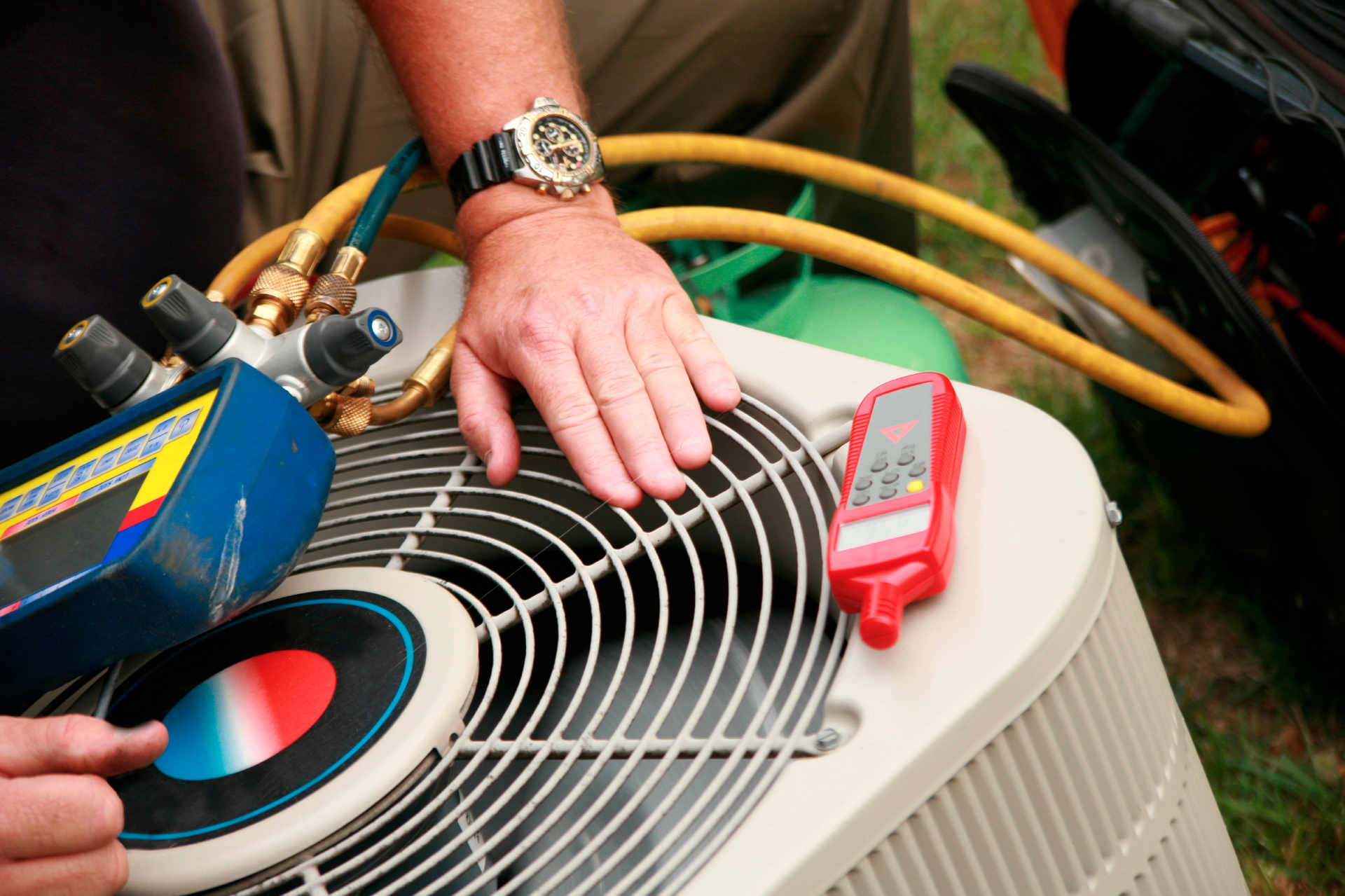
A basic digital thermometer or infrared thermometer provides far more information than feel alone. Measure return air temperature at the grille and supply air at a supply register after the system has run 20 to 30 minutes. A sensible range for delta T, the difference between return and supply, is 14 to 20 F for most residential systems on a warm Tucson day. Older systems or systems sized differently may fall slightly outside that range, but anything below 10 F or above 30 F warrants investigation.
If you own a multimeter, you can also verify the thermostat wiring and basic voltage at the air handler or condensing unit terminals, but do not perform work you are not qualified for. Safety first, and shutting power off before opening panels is mandatory.
What to test outside the unit
Assessing the outdoors equipment tells you if the repair solved the root cause. Check refrigerant lines for visible oil stains or frost patterns that indicate leaks. A light film of oil around fittings can be normal after a repair, but progressive oil streaks mean a leak. Look for signs of sweating or uneven condensation on the larger suction line. The line should be cold to the touch when the system runs and insulated from outdoor heat.
Drainage and condensation handling are also part of the repair check. The condensate drain should be free-flowing. Pour a small cup of water into the primary drain pan and make sure it empties promptly. Slow drains can cause overflow switches to trip or water damage in the attic or crawlspace.
A short checklist to take outside with you
- The condenser fan runs smoothly and without loud noise. Refrigerant lines show no new oil stains or abnormal frost patterns. The outdoor unit base is level and clear of debris or vegetation. The condensate drain empties freely into the drain or trap. Electrical connections inside the outdoor disconnect are secure, with no burnt marks visible.
Note the list above is compact, practical, and suitable to read while you are standing at the unit. If anything fails here, take clear photos to send to your HVAC contractor for documentation.
Watch the system cycles
A common problem after repair is incorrect cycling. A healthy AC runs in longer, steady cycles on hot days, typically 20 to 30 minutes depending on system capacity and house load. Short cycling, where the unit runs for just a few minutes then stops, stresses the compressor and reduces dehumidification. Overly long runs that never reach target temperature point to low refrigerant charge or poor airflow.
If the technician replaced a capacitor, contactor, or compressor, short cycling might appear immediately if the replacement part was faulty or if the underlying issue, such as low refrigerant, was not addressed. Keep a log: note start and stop times over a couple of hours, the corresponding indoor temperature readings, and the thermostat settings. These details help a contractor diagnose intermittent problems.
Measure airflow and filter condition
Airflow is often underestimated. A dirty filter, blocked return, or closed vent can reduce airflow enough to trigger freeze-ups or compressor overheating. Inspect the filter used, and if the tech left the worksite with a dirty or mismatched filter, ask for the correct MERV rating for your system. For most Tucson homes, a MERV 6 to 8 filter balances filtration and airflow, while higher MERV values require consideration of the blower capacity.
You can perform a basic airflow check without instruments by comparing temperatures at several supplies and returns and by feeling for strong, steady airflow from registers. A weak draft at multiple supplies suggests either a blower issue, an obstruction, or closed dampers. If you have an anemometer, measure cubic feet per minute at a few registers and compare to the system documentation or the contractor’s expectations.
Look for residual or repeat electrical issues
Electrical problems can be subtle. Flickering lights when the compressor starts, a burning smell, or warm electrical panels signal trouble. After a repair, monitor the circuit breaker that feeds the air conditioner for trips. If the breaker trips repeatedly, do not reset more than twice without calling the contractor. Persistent trips point to an overloaded circuit, incorrect wiring, failing start components, or a short in the system.
If the contractor replaced a capacitor, listen for a humming noise that persists after the compressor starts. That can mean the capacitor is underperforming. Ask the technician to show you the replacement part and the readings they took with a capacitance meter. A reputable HVAC contractor in Tucson should gladly review their work with you.
Document performance and expectations
You should leave the repair with a clear idea of what the technician did, why they did it, and what you should expect now. Ask for plain language: the parts replaced, whether refrigerant was added, the final pressures if they were measured, and any warranty on parts or labor. Good contractors leave a service report that lists these items and photos of any damaged components.
If your contractor is a local company like Plunkett Home Services, they often provide follow-up support and will schedule a callback without argument if a problem reappears within a warranty window. If your technician seems evasive or cannot provide simple numbers, consider documenting everything and getting a second opinion.
When to call for a follow-up
Some problems are urgent and require immediate attention, such as a burning electrical smell, large refrigerant leaks, or total loss of cooling on a 105 F day. Other issues are less urgent but still need a prompt fix, like small refrigerant losses or minor drainage issues that will worsen over time. Call for a follow-up if you observe any of the following: short cycling, poor temperature differential below 10 F, visible oil on refrigerant lines that increases after operation, tripping breakers, or water leaking inside the house.
If the contractor performed an emergency AC repair, ask about emergency service hours and response times. In Tucson heat, a same-day or next-day return can be critical to prevent property damage or health risks.
Understanding trade-offs and realistic expectations
Not every repair will return a system to new performance. If the system is over 12 to 15 years old, restored operation may simply mean it runs again, not that its efficiency matches modern units. Refrigerant top-ups on older systems might temporarily improve performance, but a leak left unsealed will recur. Compressors that have suffered heat cycling may be more prone to failure even after repair. Discuss with your contractor whether a repair is a stopgap or a solution intended to extend life by several years.
When an installation was part of the visit, verify sizing and duct considerations. A correct AC installation in Tucson must account for high infiltration, attic heat load, and floor plan. An undersized unit will run constantly and never meet the thermostat setpoint. An oversized unit will cool quickly but leave the house humid because it does not run long enough to dehumidify. If you suspect a mismatch, request a load calculation and a written explanation.
Practical examples from field experience
A caller once had a new capacitor installed, but the system kept short cycling. The first technician replaced the part and left, confident the job was done. The homeowner logged the runtime and shared it at a follow-up visit. The problem turned out to be a cracked fan blade causing imbalance and intermittent fan stall. The second visit required a different fix, but the documented runtimes made diagnosis faster.
Another homeowner reported weak cooling after a repair that involved a compressor clutch. The contractor had added refrigerant but did not verify pressures. Measuring subcooling and superheat revealed the system was slightly overcharged for the low ambient that day, which caused poor expansion and reduced capacity. Adjusting the charge after proper measurements fixed the issue.
How to talk to your HVAC contractor
Be specific and unemotional. Describe what you saw, when you saw it, and what you expected. If you took photos or logged temperatures, share them. Ask for the service report to include the readings they took: pressures in psi, amperage draw in amps, and any temperature differences. A solid HVAC contractor near me will appreciate details because they reduce the time needed to find the root cause.
If you need help deciding whether to repair or replace, ask for the cost to repair, the expected remaining life, and the estimated efficiency difference compared to a new system. When Plunkett Home Services or another local contractor presents options, have them itemize savings from improved SEER ratings and any available rebates or financing. That makes the trade-off concrete.
A final practical checklist before the technician leaves
- Ask the tech to run the system until it reaches steady-state, and then walk through the house with them to feel supply registers and listen for unusual sounds. Request a copy of any measurements taken, including delta T, refrigerant pressures, and electrical readings. Confirm the warranty terms on parts and labor, and ask how to schedule a warranty callback if the problem reappears. Verify the filter type and replacement interval, and make sure the filter was installed correctly. Take photos of the outdoor unit nameplate and any replaced parts, and file them with the service report.
Testing your AC after repair is not about proving the technician wrong, it is about ensuring the work solved the problem and your home is safe and comfortable. In Tucson heat, prompt verification protects you from repeat failures, hidden leaks, and unnecessary expenses. Use simple measurements, clear documentation, and direct communication, and you will usually get the reliable performance you paid for.
Plunkett Home Services
3144 E Fort Lowell Rd, Tucson, AZ 85716, United States
+1 (520) 808-2743
[email protected]
https://callplunkett.com/